antigravity craft: the government’s argument against having them
If a device producing an anti-gravity effect of even one percent had been discovered here on earth, it is very unlikely that such a momentous discovery would have gone unnoticed and unreported. It is even less likely that the technology would have appeared in a completely developed form, ready to be built into a military aircraft such as the B-2. Usually, scientific progress begins with very small effects that indicate that something much larger may be present. The development of atomic energy is an example of this. Long before the development of either nuclear energy or nuclear bombs, scientists noticed anomalous emissions of energy from certain heavy substances. Research eventually revealed that the substances emitted radioactive particles. Further research isolated the particular atoms involved in these emissions, and this, in turn, led to the discovery of a single isotope of Uranium (U-235) that was able to undergo spontaneous fission into lighter elements, and this led to the atomic bomb and eventually to nuclear energy.
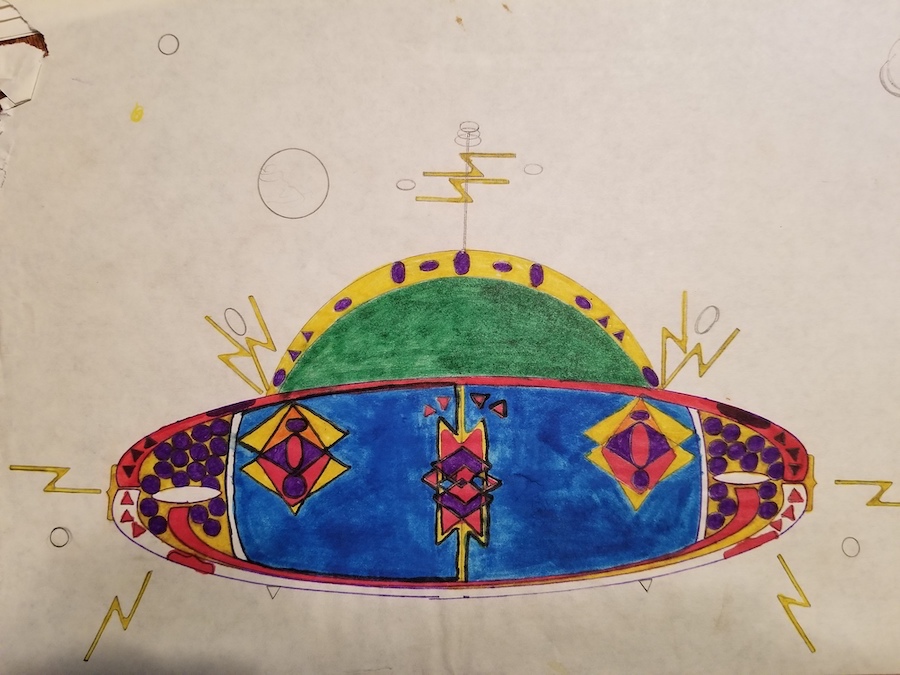
drawing by bc
It is likely that when anti-gravity is discovered, like the discovery of radioactive atoms, it will be discovered in certain types of materials. This is what was claimed to occur for the gravity-defying materials in the Finish experimental device. At first, the anti-gravity effect will be very small. The scientists who will study it will isolate and concentrate the atoms responsible for it, and the effect will increase measurably. Eventually, a comprehensive theory will emerge that will predict what types of materials will produce these effects under what types of conditions, and the anti-gravity age will begin. As of the millennium, however, it has not begun.
As nuclear theory developed, it was reported in scientific journals. Initially, there was no thought of keeping it secret, because when it was first discovered, there was no indication that someone might be able to use it to build a bomb. After many years of R & D, the idea of a bomb occurred to a few scientists, but even then it was ignored until the outbreak of World WarII.
If anti-gravity had been developed in materials, it is likely that it would have developed in several places at the same time, and reports of it would have appeared in at least a few journals. No such reports have ever appeared, with the exception of the recent Finish experiment that initially appeared on the Internet and was, as a result, immediately reported worldwide. If you developed anti-gravity, wouldn’t you want the world to know about it? Wouldn’t this be the best way to acquire funding for it? It can be safely concluded that if anti-gravity had been discovered here on earth, someone somewhere would have reported it.
By now it must be apparent to the reader that the most advanced earth technologies have not yet reached the point where they would be able to develop it. For the most part, the technology is still beyond our reach. How soon it will be in our reach is an open question.
As an adjunct to this theory, I would suggest that the term UFO be changed to the scientific term “FFC,” which stands for “force field craft.” This term summarizes the scientific meaning of the UFOs propulsion system, which is based upon the onboard production of artificial gravity and space-bending fields. The term “field” is critical to this description, as any rocket could be described as a craft that develops a propulsive force that moves it through space.
There are two basic categories of fields, those that operate under the influence of electrical charges and those that do not. Electrostatic and magnetic forces are in the first category, while gravity and the nuclear forces are in the second. Electromagnetic forces either attract or repel, while the others always attract (as far as we know).
The main reason why scientists and engineers have been slow to accept UFOs is that their propulsion systems have not been described in terms that are acceptable to the scientific community, because they cannot be described by the existing laws of physics. Because they do not know what UFOs are, these very pragmatic people usually reject their existence without even examining any of the written or photographic evidence that has been compiled over many years by people who have been investigating UFOs. If this theory is an accurate description of physical reality, then we must have a scientific term for UFOs, so I will use this one in the text whenever I am describing the propulsion systems of these craft. With respect to any other descriptions, the traditional terminology will be used.
This report does not have the time, nor the author the inclination, to go into the UFO phenomenon in any greater depth than is necessary to explain UFOs as FFCs (Force Field Craft). This only requires an examination of the flight characteristics of these craft, as well as the physical evidence they leave behind. It does not require any type of extensive examination or investigation into the occupants of the craft, where they come from, why they are here, possible/probably government involvement and knowledge, etc. There is a plethora of information on these and many additional subjects in the UFO field. Explaining what these craft are in a physical sense, and explaining how they defy gravity and move through the air will be a large enough task for this paper.
People in the government are determined to control information on the material/physical nature of UFOs, but it does not care if people discuss the social and metaphysical nature of the phenomenon. The people responsible for the UFO cover-up do not have to worry about the public believing in the more exotic and unbelievable aspects of the UFO phenomenon. To this date, many UFO researchers and writers still emphasize the same physical aspects of these craft that they have been emphasizing for the past fifty years. UFOs, they say, can only conclusively be described as flying lights, flying metal objects that perform impossible maneuvers, objects that leave landing marks, and other such physical descriptions.
While it is easy for the person who does not study UFOs to believe in the possibility of these types of descriptions, belief in alien beings requires the first leap of faith. If a person is able to make the first leap of faith, they can then go onto the second leap of faith. This involves stories of alien activities, such as the abduction of people, cattle mutilations, crop circles, underground bases, secret alien-government treaties, etc. By the time a person believes in these things, they are no longer part of the general public that believes in the existence of UFOs. They are now part of what the government people can call the “fringe” of the movement. Since most people do not want to be associated with people on the fringe of anything, the cover-up is easily maintained.
The most reliable UFO sightings and reports have come from highly-trained aircraft pilots, both civilian and military, who have described the UFOs that they saw as being solid objects that were moving through the skies. This theory also leaves open the idea that because UFO sightings are creations of the human mind, they could be hallucinations of real objects rather than the real objects themselves. This idea returns us once again to the idea that UFOs are objects from our mythological past, and should not be taken in any other context.
While the idea and technology of spaceflight has been with us for some time, we are only just beginning to explore how the brain functions. We feel more comfortable with the idea that UFOs are spacecraft with an unknown means of propulsion than we are of the idea that this same technology interacts with the brain and mind. The introduction of the mind-brain hypothesis in recent UFO literature is now an important aspect of the phenomenon. Its existence, however, should not interfere with the other more established hypotheses, nor should it compete with it for popularity or exclusiveness as to which explanation best fits the evidence.
THE SPACECRAFT HYPOTHESIS
Once it is assumed that the UFO phenomenon is fundamentally technological, some of the unease and disbelief surrounding UFO reports will begin to dissipate as people come to accept the fact that these craft only seem to violate natural law because all of natural law has not been discovered or defined.
It is now apparent, after thousands of sightings and thousands of reports, written and verbal, that UFOs are part of a technology that is as far advanced over ours as ours is over the technology of the wheel. Rather than repeating all of the evidence that has been offered by these writers, this paper will summarize some of the most obvious evidence that is indicative of an advanced propulsion system. This evidence will be divided into three different categories:
1. Gravitational effects that happen to persons and objects that have come close to a UFO.
2. The observed flight performance of UFOs.
3. The phenomenon of electromagnetic emissions (including light) in conjunction with the flight of UFOs.
There are many reports of UFOs levitating people who were outside to some other location inside. This levitation is described in terms that indicate the UFOs generate their own gravitational field. One of the largest sources of these cases is the recollections of many of the people who claim to have been abducted and taken on board a UFO by small alien beings. In many of these cases, the abductees have reported being lifted out of their beds at night, and then floated through space out of their houses into a room in the craft. Often, abductees report that a beam of brilliant blue-white light was used to transport them into the craft.
There also are many reports of UFOs lifting motor vehicles off the ground, or else shaking them violently during a close encounter. These, too, suggest that UFOs are able to either shield the earth’s gravitational field, or else are able to produce their own gravity, which then pulls objects in a different direction from the earth’s gravity. In either event, gravity is one of the most prominent events associated with UFOs.
One of the most controversial and interesting areas of UFO research involves descriptions of their flight performance. They have been seen to accelerate suddenly to speeds that are well beyond the capability of any known aircraft or even rockets. To make matters even more perplexing, these accelerations are not accompanied by the loud noises that we have come to associate with the flight performance of jets and rockets.
These reports suggest that the UFO technology is based upon the manipulation of a force that is not produced by the combustion and rapid expansion of gases, as is the case for our current generation of space rockets and jet aircraft. Although lights are often seen in conjunction with UFOs that are maneuvering through the atmosphere, these craft have not been seen riding on top of a bright plume of exploding gases.
If anything at all is heard from a UFO by the observers who have come close to them, it is only a low level humming or whirring sound, a sound that many observers have compared the sound of an electric motor or generator. If these sounds have an electrical origin, we have found another clue to the propulsion systems of these craft.
UFOs have been observed making turns that are so sudden and sharp as to defy the accepted laws of inertial mass and momentum. These laws are the foundation that most of our modern physics and engineering are based on. They have become so ingrained in our thinking that we do not think twice in rejecting the idea that a massive object, such as a spacecraft, could possibly execute a right angle turn. Yet UFOs have been observed making these types of turns, and explaining them is tantamount to revising all of the traditional laws of physics that have to do with mass, inertia, and momentum.
Even if the UFO spacecraft produce their own gravity and use it as a propelling force, the inertial mass of the craft resists any changes in motion (Newton’s First Law). If the craft were to change its direction with one of these sudden turns, the mass of the atoms in the bodies of the people on board would want to continue in their original direction. The force derived from the sudden change in motion would tear any living thing to pieces without the intervention of some unknown physical laws or effects that were a byproduct of the operation of the craft’s propulsion system.
The rapid rates of acceleration for these craft can be easily explained by the use of an unknown propulsion system that is capable of delivering extremely high rates of acceleration. Such a propulsion system does not, however, negate the physical property of inertial mass. If gravity were to suddenly change and begin to pull us up instead of holding us down, although we would still feel its effects, it is just that we now would feel it pulling up in an opposite direction.
What the right angle turns of the UFOs is suggesting is that we would not feel any change if gravity changed its direction. This idea is not consistent with what we have learned about the effects that a change in motion would have upon the object that is undergoing the change. If gravity changes its direction, then we should experience it the same as we experience any change in motion. So how do we explain the right angle turns?
The answer to this question is that we cannot explain them in terms of the known physics of mass and inertia. They are explainable, however, if it is assumed that these craft operate according to the new physics that was first described by Albert Einstein in the early years of the Twentieth Century. His theories of General and Special Relativity provide us with descriptions of physical reality that can be used to account for the right angle turns of UFOs.
Although this subject will be discussed in greater detail in a later section, it is important for now to understand that relativity theory can be used to account for many of the observed characteristics of UFOs, or events that are associated with UFOs. If a UFO is observed at a velocity that is close to the speed of light, this theory predicts changes in all of the physical dimensions that we normally use to measure the size, distance, and mass of an object. Such changes can only now be produced for infinitesimally small particles, such as electrons or protons, but there is no reason that they cannot occur for larger objects. In fact, the theory demands that they do occur for all objects and particles.
In addition to his theories of relativity, Einstein also proposed the general theory of relativity, which is a theory of gravity. In this theory, the movement of objects under the influence of gravitational fields is caused by curvature of the space that the object is moving through. Objects that are moving under gravity are guided towards each other by the imaginary lines-of-force of a gravitationally curved space.
In the general theory of relativity, the dimensions of space (and time) change for an object when its velocity approaches the speed of light. This theory implies that gravity is a “relativistic event” that is equivalent to the events that occur at the speed of light. At the speed of light, the normal straight lines of space are bent into curved lines, but in Einstein’s theory of gravity, the same thing happens, and a gravitational field is not really a field of force and acceleration, but is instead a curvature in space. In this theory, objects are no longer seen as accelerating under the influence of gravity. Instead, they are seen to fall into gravitational holes in space.
In addition to reports that suggest control over gravity and inertia, there are many electromagnetic phenomena that have been observed to occur in the vicinity of these craft. There are many hundreds, possibly thousands, of reports that fall into this category. Automobile ignition systems have been reported to fail, burn marks have been reported where UFOs have been seen to land on the ground, and interference with the radio, radar, and telemetry systems of commercial and military aircraft have all been reported when UFOs were observed in close proximity. All of these reports suggest that the UFO’s propulsion system is either directly or indirectly connected with the production of electromagnetic fields.
The theories about the connection between UFOs and electromagnetism fall into two broad categories, those that state that electromagnetism is directly responsible for the craft’s means of propulsion, and those that state that it is only an observed byproduct. The theory of “electro-gravitation” comes under the former category, while the electromagnetic effects of UFOs have been discussed by several authors.
It has been suggested that microwaves from the UFOs are responsible for interfering with the ignition systems of motor vehicles. While this is entirely possible, it is equally possible that a powerful local magnetic field could be responsible for these events. No matter which explanation is preferred, no scientific data on the magnitude and frequency of the electromagnetic fields that come out from UFOs has ever been collected. Apparently, no one who was close to a UFO has ever had electronic detection equipment, such as frequency analyzers and oscilloscopes, with them at the time of their encounter.
Several military pilots have reported equipment failures when they approached too closely to a UFO in their jets, but if any electromagnetic radiation coming from the UFO was detected on their radar equipment, they are not reporting it to the public. There are also many reports from air traffic controllers at civilian airports that UFOs have appeared on their radar screens. In some cases, the radar sighting of a UFO was confirmed by a visual sighting by ground observers or pilots. While this is an example of what might be considered good evidence for the existence of the UFO, it tells us little about the exact nature of its electromagnetic emissions.
As the theory of force field propulsion unfolds in these pages, it will become apparent that a great deal of electromagnetic energy is required to produce a force that is adequate to lift a spacecraft. It will also become apparent that the frequencies that are required for the operation of the craft’s electronic generators and accelerators include a wide range of possible frequencies in the radio and microwave bands, any of which would be able to disable automobile ignition systems if they were produced at high enough levels of energy.
The theory of force field propulsion will explain how the force field that is used to lift and propel spacecraft is produced by electromagnetic fields and electromagnetic laws. Because it defines a connection between the laws of electromagnetism and those of gravity, it really amounts to a theory of electro-gravitation.
The spacecraft hypothesis is not only the oldest explanation for UFOs, but it is the best one as well. Its only drawback is that it still remains for the scientific community to explain what UFOs really are, rather than explaining what they are not, and why they could not even exist. Possibly, the failure of the scientific community will come to an end once a viable theory of spacecraft propulsion has been put forth.
GRAVITATIONAL LIFT
To use gravity to lift a spacecraft into outer space, one generates a gravitational field and places it over one’s head. When the strength of the new gravitational field exceeds that of the earth’s gravitational field, the new gravity pulls upward instead of downward, and that is the direction that you will travel. The term “artificial gravity” is used here because even though the gravity that is produced by the UFO propulsion systems is the same gravity as the earth’s gravity, it has been artificially increased and amplified by the ship’s gravity generators to the point where it now exceeds the earth’s gravity.
In gravitational lift and propulsion, the craft’s center of artificial gravity is placed above its center of mass, and the latter is attracted toward the former when its magnitude exceeds that of the earth’s gravity. But the gravitational propulsion unit is mounted rigidly into the hull of the craft, and the craft’s center of mass is never able to reach its center of artificial gravity. The gravitational attraction between these two centers continues indefinitely and the spacecraft moves indefinitely in the direction of the line that runs from the center of mass to the center of artificial gravity.
In addition to providing lifting power, the center of artificial gravity can also be used as an artificial onboard gravity for the ship’s occupants. To do this, the craft’s passenger and crew compartments must be placed above its gravitational propulsion units. This can be seen in most of the photographs and drawings of FFC, which show that the circular cupolas that are the craft’s passenger and crew compartments are always located on top of the saucer-shaped hulls.
One would assume that if it is possible to control gravity and produce a gravitational field that exists separate from matter, that the phenomenon would have already have been discovered. This is, in fact, the case. However, the reason that the phenomenon has not been widely recognized is not because it has not been discovered, but because it was not recognized for what it was when it was discovered.
Understanding the propulsion systems of UFOs only requires an understanding of the general and special theories of relativity, the former because it defines the nature of gravity, and the latter because it describes how to produce a gravitational field.
McCampbell points out in his book, Ufology, that Einstein’s Principle of Equivalence states that it is not possible to distinguish gravitational forces from inertial forces. This implies that the gravity that Newton defined as being intrinsic to all bodies is the same thing as the inertial mass that Newton defined in his three laws of motion. If this is the case, then if an object or particle has its mass increased, which is what happens when the objects or particles approach the speed of light, it must also have its gravity increased.
The increased gravity that is derived by accelerating things up to the speed of light is contained in a field which acts on all matter that is in its vicinity equally. This means that once a small number of particles have had their own intrinsic gravity increased, that gravity is able to act upon all other particles and objects that are in the vicinity, even though they are not in motion, and even though they have not had their own gravity increased.
When a particle’s mass is increased, so is its weight. The particles that generate the gravitational field of an FFC only add dead weight to the total weight of the craft. But the gravitational field that they produce during acceleration not only counteracts this weight, but provides lifting power to the entire craft.
Gravitational lift and propulsion become force field lift and propulsion when the gravitational field is transferred to (acts upon) the matter in its vicinity. Force field propulsion is possible because the lifting force of gravity resides in a field of potential energy. While the mass of a particle or object cannot affect any other particle or object directly, its intrinsic gravity can, because it is contained within a field.
Before the connection is made between relativity, gravity, and force field propulsion, it is necessary to fully understand how physics defines mass and gravity. This understanding was given to us by the leading mathematician of the modern era, the first true physicist, Isaac Newton.
Isaac Newton defined the relationship between mass and gravity with his equation:
F = GMmd2
In the equation above, the product of three quantities, two objects with masses “M” and “m,” and the Universal Gravitational Constant (G), when divided by the square of the distance between the objects (d), gives the amount of gravitational force (F) between the objects. If the small mass (m) is your body mass as you stand, and the large mass (M) is the mass of the earth, and you are standing on the earth’s surface at a distance (d) from its center (about 4,000 miles), the equation will tell you how much force you are exerting on the earth as you stand on it.
The constant “G” defines the amount of gravity inherent in an object. As far as modern science has been able to determine, this is an absolute and invariable constant. If “G” did change, all of the planets and stars would change their orbits and there would be chaos in the universe.
When Newton defined gravity, he did so in a manner that made it an entirely separate physical quantity from mass. The masses of the two objects (M and m) are used to define gravity, but do not necessarily contain gravity, that is, they are not the same thing as gravity. By defining gravity in this way, Newton left us with the impression that they are separate and distinct physical effects. While this is true to the extent that they act differently, it is not true in that both effects are derived from the same single cause. This problem would not be straightened out until Einstein came along with his theory of relativity, which, among other things, made mass, gravity, and energy all equal. Mass is equal to energy because of “E = mc2,” and mass is equal to gravity because when an object moves under the influence of gravity, it either stores or releases energy.
Newton’s equation for gravity says nothing about what a mass is or how it acts under the force of gravity that it defines. These questions were answered when he defined mass as “the measure of inertia.” Among other physical actions, mass (m) experiences a force (F) when it is subjected to an acceleration (a), as given by the equation:
F = ma
Gravity is not a force unless it acts on a body with mass. When it does this, the body’s mass (m) is multiplied by the earth’s gravitational constant (g) to find its weight:
W = mg
The weight of a body is a downward acting force that is always in operation.
The force an object exerts when its motion is changed (F = ma) is produced by its inertial mass, while the force of its weight is produced by its gravitational mass. Newton’s Law of Universal Gravitation says that gravitational mass is distinct from inertial mass, but in his later laws of motion, mass and gravity produce forces that are defined by similar equations:
(F = ma; W = mg)
This is the first indication that these two properties cannot be separated.
At the time that Newton defined his theory of gravity, there was a great deal of controversy as to what it really meant. Science was just beginning to take over from religion during these times, and it was necessary for a scientist to state the philosophical implications of his theory so that it could be discussed in terms that would be comprehensible to the religious thinkers of the day. This is what Newton had to say about the nature of what he had discovered:
“It is inconceivable that inanimate brute matter should, without the mediation of something else which is not material, operate upon and affect other matter without mutual contact…And is why I desired that you not ascribe innate gravity to me.”
Newton says two important things in this statement. One is that he personally did not discover gravity. The other is that the Law of Universal Gravitation does not say what gravity is, it only says how it operates. In this statement, Newton also lays the groundwork for the discovery of “something else” that is the actual source for gravity. But it would take a long time before anyone else tried to define the nature of gravity. Ideas and theories other than Newton’s about the “something else” that is gravity do not occur in the scientific literature for another two centuries after the time of Isaac Newton.
The breakthrough in gravitational theory came with the statement and publication of the special and general theories of relativity by Albert Einstein. These theories are not usually described together. This is because one deals with mass (the special theory) while the other deals with gravity (the general theory). When the two are integrated into a single theory, the principle of mass-energy equivalence can be stated, and the principle of mass-gravity equivalence can be stated.
A great deal is known about the equivalence of mass and energy as defined by the famous equation: E = mc2. The entire modern age of nuclear physics, bombs as well as reactors, would not have been possible without his equation. Far less is known about the equivalence of mass and gravity. This should not be the case, however, as these types of reactions are studied every day in physics labs around the world, and are as common as the mass-energy reactions.
To go a step further, it can be safely stated that there are already several hundred machines on the earth that are capable of producing their own gravitational force fields, and as such, amount to spacecraft propulsion units. The current difficulty with these machines is that they do not produce their “artificial gravity” very efficiently, and are extremely large, even massive, and expensive to build, and can produce only small amounts of gravity. Currently, the weight of these machines makes them unsuitable for mounting in a spacecraft that must be accelerated to at least 18,000 MPH to achieve orbit or 25,000 MPH to escape from the earth’s gravity and go into deep space. However, this does not mean that the technology that is used to build these devices cannot be improved to the point where they would be light enough to carry into space. In fact, these machines are constantly being retro-fitted with newer and better components that improve both the efficiency of their operation and the magnitude of their gravitational fields.
The machines that produce a gravitational-type force are particle accelerators. Currently, it is assumed that these machines only increase the mass of the particles that they accelerate up to the speed of light, but Einstein’s principle of mass-gravity equivalence clearly states that if a particle’s mass increases, its intrinsic gravity must also increase by the same degree and at the same rate. But this principle is not used by the current generation of particle physicists, and in ignoring it, they have missed a very large and important physical phenomenon, the development of artificial gravities, that is, gravities that are in excess of Newton’s gravitational constant.
In reality, the particles that are accelerated in these large machines are producing, or more correctly are tapping into, a field of “infinite gravity” that increases their weight by increasing their masses and their gravities simultaneously. The conventional interpretation of the special theory of relativity is that only the mass of an object is thought to undergo an change at the speed of light. This is clearly an inaccurate and incomplete interpretation of what is happening when a particle is accelerated to the speed of light. What really happens at the speed of light is that both the particle’s mass and its gravity are increasing. The product of mass and gravity is the particle’s weight, and this is what is increasing at the speed of light.
The increased or relativistic gravity of a particle at the speed of light is the same gravity that is used to both lift the UFO spacecraft off the ground and to propel them through space. FFC accelerate large numbers of charged particles up to velocities that are so close to the speed of light that the total of their masses (and gravities) are magnified until they become as heavy as the earth. The gravitational field component of the accelerated particles then attracts all of the material that makes up the craft toward it, and the craft moves in that direction. The ship is maneuvered by changing the direction of the vector (straight line) that runs from the center of artificial gravity to the center of mass.
Gravitational lift is a physicists dream for a propulsion system, as it embodies the “bootstrap” concept of lifting objects. This is supposed to be impossible way of lifting objects, but it was actually tried by many people after the discovery of magnetism. These people thought that the constant pulling force of a magnetic field could be used to lift a ferromagnetic object against the force of gravity. Since the new laws of magnetism were outside of those of gravity and Newton, there really was no reason (they thought) why a magnet could not be used to lift an object to any desired height. Needless to say, when these people built a device that tried to use a magnetic field to bootstrap a steel object into space it failed miserably, and that was the end to the idea of using a force that was internal to an object to lift that object.
But the gravitational force of an FFC is not actually connected to its mass, as the magnets were connected to the steel objects that they were to lift. The particles that are used to produce the craft’s gravitational field never come in contact with the actual mass of the craft. They circulate endlessly inside the craft’s main accelerator tubes. This means that the field that they produce also is separate from the mass of the craft. As we will see later when the general theory of relativity is described, the gravitational field is not an actual force field, but is instead a curvature in space. The propulsion system of an FFC does not actually produce either a gravitational acceleration or a gravitational force field. According to relativity theory, it curves the space around the craft in such a manner that the craft now is able to fall upward into a new gravitational hole instead of downward toward the earth’s gravitational hole (the center of the earth).
While this explanation for UFO propulsion is on sound theoretical ground, being based upon the principle of equivalence between mass and gravity, it can (and will) be argued that it is perhaps not on very sound practical ground. The reasons for this have to do with the shortcomings of our current particle accelerator technologies, which are not able to accelerate charged particles (electrons and protons) to velocities that are necessary to nullify the weight of a spacecraft. Objections to the application of this theory to the actual building of spacecraft, however, are only valid with the current state-of-the-art accelerator technology. It is possible, indeed likely, that this technology will improve along with all other technologies, and that force field propulsion will become a reality in the not too distant future.
FORCE FIELD CRAFT
Figure ??[:sic] shows the basic design pattern that is used for all of the saucer-shaped FFC. This design shows how these ships are organized into three basic levels, each with a different function. It also shows how the center of artificial gravity is used to attract the ship’s center of mass in an upward direction.
The ship’s electrical generators and generator drive mechanisms are mounted on the first level. These components are the heaviest ones that are used in the FFC, and their placement on this level gives the craft a low center of mass.
The ship’s force field propulsion system is located inside its second or middle level. The force field is developed inside its toroidal shaped particle accelerator tubes, which are mounted just inside the outer rim of the craft. The diameter of these tubes is slightly less than the diameter of the ship’s saucer section. The circular shape of most UFOs, whether cylindrical or saucer, is also a product of the circular shape of the propulsion system’s toroid tubes. Although it is possible to mount one of these circular shaped propulsion systems inside a ship that is not circular, this is rarely done, because the ship’s gravitational and electromagnetic fields all operate through circular or spherical geometries, which means that a rectangular or triangular ship would have unbalanced fields.
The cupolas and domes that have been seen on the top of UFOs carry the ship’s occupants. These structures are always located in the craft’s third or upper level. The main reason for this location has to do with the need for an onboard gravitational field during spaceflight. Normal bodily functions are disrupted in the zero gravity environments of outer space, but not in one of these craft, as they have the luxury of carrying their own local gravitational field around with them. This is the same gravitational field that pulls upward on the ship’s center of mass, giving it its upward acceleration against the earth’s gravity. Inside the third level, however, it pulls downward on the ship’s occupants and gives them the illusion of being on the surface of a massive planet such as the earth.
The occupants of a FFC must be shielded from the harmful electromagnetic radiation that is a byproduct of the operation of the ship’s electrical generators. These generators are located on the first level, as far away from the ship’s occupants as is possible. However, the electromagnetic fields are very intense, involving the continuous production of several million watts of electrical power, an amount that would be harmful to the ship’s occupants if their quarters were not shielded.
To accomplish the shielding of the ship’s occupants, their compartment on level three is lined with a powerful superconducting material. A magnetic field cannot penetrate into a superconducting material, and so when it is used as a floor material, the magnetic field will also be blocked from entering into the interior of the compartments on the third level.
The main propulsion system is located on the bottom side of the FFC, far enough away from the ship’s occupants so that its nuclear force field cannot harm them. Like the secondary or environmental field, this field is also derived from the acceleration of charged particles. But unlike the secondary system, the particles that are used in the main system have high initial energies before they are used in the propulsion system. The secondary system, on the other hand, uses low energy particles as its main source of material fuel.