quantum force and gravitational waves
If you would like to review the original documents with the original formula alignment, please view the pdf here.
the.Qgrav.
In the current theory of quantum gravity, the force and influence of the gravitational field are spread throughout space by interacting gravitons. With countless gravitons interacting constantly throughout all of space, gravity effectively occurs everywhere in space. This view of gravity agrees with the view of space that has emerged over the years from quantum theory, the math of which (the Schrodinger Equation) predicts that quantum particles such as photons and electrons maintain contact with one another through space. The inevitable conclusion of quantum mechanics then is that quanta and gravitons are part of a field that spreads quantum properties throughout space and keeps similar particles in touch with one another.
Quantum theory assigns quanta, particles, and gravitons spin numbers to distinguish them from one another and to account for their decay products. Photons have spin 1 and can decay into particle-antiparticle pairs where each particle has a spin number of ½. Spin 1 particles then decay into two spin ½ particles. Gravitons are spin 2 particles. With this spin number, they should decay into two spin 1 photons. While this has never been observed, it follows the rules of quantum theory.
While the graviton has been proposed it has not been detected and it cannot be said with certainty that it exists. Quantum Gravity may provide a model that explains gravity, but it is possible that it can be explained by a different theory. This paper will propose a theory that defines how the graviton is produced from the photon’s DeBroglie wave component, and how this aspect of the photon is a force that is transmitted through space by secondary DeBroglie waves that are produced when the initial or first-order wave reacts with itself and produces an extensive spectrum of low-frequency waves. It will be seen that this concept of gravity does not contradict one of its basic properties – that it is as Newton proposed proportional to mass. It only proposes that atoms make their own gravity, and that gravity is similar to the forces that hold subatomic particles together, the main difference being that it holds atoms to one another.
The theory begins with an analysis of the DeBroglie wave and how it produces a force from the photon’s momentum. The DeBroglie Equation is:
 Eq.1
Eq.1
In Eq. 1 the momentum of the photon (p) is equal to Plank’s constant (h) divided by the photon’s wavelength ( ). Momentum produces a force when it changes through time. In the classical physics of Newton, the force generated by a change in momentum is defined by:
In Eq. 2 the force (F) produced when an object’s momentum, its mass (m) times its velocity (v), undergoes a change through time (d/dt). However, while the momentum to force conversion is simple and straightforward in the old physics, it is complicated in the new physics of quantum theory. This is because photons do not slow down under very many circumstances, and when they do it is only by a small amount. An example where the speed of light decreases occurs when light is transmitted through a transparent medium. When this happens, the material’s internal electric fields, which are produced by its ions, bend the light through a small angle, and the ratio of the normal or vacuum speed of light to the decreased speed of light is the material’s index of refraction.
The bending angle of light through an optical medium also increases as its frequency increases (as its wavelength decreases). High-frequency ultraviolet light (UV) for instance, has a higher index of refraction than visible light. This phenomenon has implications for what this theory is proposing, as it means that only short wavelength light (photons) are easily absorbed into nuclei, and that only these have their momentum converted into a force. The shortest wavelength photons are gamma rays, which are emitted when radioactive isotopes decay.
Gamma rays are not only emitted by radioactive atomic nuclei, they are absorbed by them, and when this happens their energy is converted into a force. This process is different than the one that occurs when photons with much lower energy are absorbed into atoms. In this case, the photon’s energy is absorbed by the atom’s orbit electrons, which then rise to higher energy orbits (their excited states). When the electron falls back to its original or ground state energy, the atom emits a photon with the same wavelength as the one it absorbed.
The mechanism that absorbs the gamma photon into a proton is the nonlinear electrical effect. This effect is an enhancement of the low level electrical effect that bends light when it is transmitted through optical materials. Gamma rays that collide with protons experience the proton’s strong electric field, which is so powerful that it bends the ray’s path into such a tight spiral that it cannot escape from the nucleus. The absorption of photon energy through electric fields results in its conversion into a force acting through (times) a distance (the equivalent of energy). The force of the absorbed photon is maintained when it is emitted back out of the proton, in which case it is carried by the photon as the weak nuclear force that occurs when the photon decays into a positron-electron pair.
There is evidence for what has just been proposed, that gamma rays produce a force. The weak nuclear force occurs when these rays decay into electron-positron pairs, and it is defined from its momentum (p):
 Eq. 3
Eq. 3
Before proceeding, it is necessary to make another change and express frequency and wavelength in terms of time period (t). First convert wavelength ( ) in Eq. 1 into frequency:
p =  ; where:
  . Eq. 4
Eq. 4 expresses photon momentum as the Plank equation (  ) divided by the speed of light. Next, express frequency as its inverse quantity, or wave period (t):
 , where: t = wave period. Eq. 5
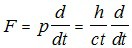
In Newtonian physics, the “d/dt” of momentum makes a force (F) according to:
 =
= =
= Eq. 6
Eq. 6
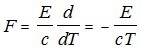
In Eq. 6 “h” is Plank’s constant, “f” is the photon’s frequency, and “c” is the speed of light. The equation’s minus sign indicates that the photon force occurs in the opposite direction of its momentum. Eq.6 defines a special case solution where the period of the photon’s reaction time (the time of the momentum to force reaction) and the inverse of its period (its frequency) are both “t.” The two-time quantities can be separated by converting frequency into energy via Plank’s constant where: E = hf. Momentum (P) then equals energy over “c” and the “P/F” reaction time “T” is defined by:
 , where: P =
  Eq. 7
Eq. 7
The second derivative of momentum is the rate of change of force, a quantity known as “impulse.” Impulse occurs when rockets or jet aircraft burn fuel as they accelerate through space. When a rocket accelerates at a certain rate by burning a certain amount of fuel per minute, the rate increases as the rocket’s weight decreases. The force that pushes the rocket or jet then equals its acceleration times the mass of its fuel. As the vehicle loses mass (burns fuel) its acceleration increases and the propelling force becomes a changing force or impulse.
Impulse (I) is the second derivative (F2) of momentum:
I = F2 = – F1  =
=  Eq. 8
Eq. 8
As force acts opposite to momentum (Eqs. 4 and 6), impulse acts opposite to force (Eqs. 7 and 8) and has a positive sign and direction. If one were to continue the third derivative of “P” is the “rate of the rate” of change of force; the fourth “the rate of the rate of the rate” change, and so on as far as one cared to go. This leads to a general equation for all derivatives of momentum:
Fn =  , where: n = 1,2,3,… Eq. 9
When quantum theory is applied to the atom, electrons absorb and emit both the energy and the momentum of photons. The absorption of energy raises an electron into its excited state, and emission lowers it back to its original or ground state. Photon momentum is absorbed by electrons in a different manner than photon energy. This quantity interacts with the electron’s angular, orbit momentum and increases it during the absorption cycle, and decreases it during the emission cycle. This is the same as what happens to the photon’s energy inside the atom, except that momentum changes the electron’s motion while energy changes its position (orbit).
When an electron absorbs momentum it experiences a force. Force, therefore, occurs inside the atom, but its magnitude is small for electrons because photon’s carry little momentum. It is a different matter, however, for the proton in the atomic nucleus. Only gamma photons are absorbed into atomic nuclei. The energy and momentum of these photons are millions of times greater than that of the photons that interact with orbit electrons. The gamma photon’s energy eventually leaves the proton (and nucleus) in the same form that it came in with, but the photon’s momentum interacts with the proton’s angular momentum and produces a force. This then is the force of gravity for the inertial mass of the proton.
Gravity is produced by the decay of photon momentum into force. This may seem unlikely in the current physics, but it is not beyond what is possible. While the derivation of force from momentum is well known, it has no current application beyond the simplistic one of the force a photon imparts to an object or particle it collides with and is absorbed into. There is no general recognition in physics that photon force affects particles (protons) other than the one it initially interacts with. But that is because physics has no knowledge of the waves that carry photon force.
Photon force waves are gravity waves. They could also be called force -impulse, “F-I” waves, or “  – waves”.
  – waves are produced by the force and impulse derivatives of momentum. The first derivative of momentum (Eq. 7) defines the
  – wave’s force phase, which carries a “-“ sign, and the second derivative defines its impulse phase, which carries a “+” sign. Together both make the total
  – wave.
The magnitudes of force and impulse are dependent on the time (T) that they occur through. For this theory “T” is defined as an interval of time such that: T ≥ 1. Time, therefore, is not measured in seconds but in intervals that begin with “1″ and proceeding up from there. With this scheme, the exponent of “T” determines the nature of the – wave. The “-” or force phase of the wave spreads force out through time, while the “+“ or impulse phase of the wave concentrates it into a shorter pulse.
The force and impulse phases of the – wave make sense when the wave’s structure is defined. The wave consists of a series of concentric spheres that propagate infinitely through space. The “+” (impulse) phase of the wave is the outward propagating gravity wave that transmits the inward or “-“ force phase into the proton’s center. The impulse of the outward wave occurs as the graviton, which current theory sees as the particle that transmits gravity throughout space. Gravity waves carry small impulse patterns like ocean waves carry fishing bubbles. They spread out as they move away from their proton source. This occurs with the inverse of the cube of the distance for the total or composite gravitational field, but when gravity waves are transmitted between a pair of objects they occur in a plane, and the inverse square defines the fall in gravity through distance.
F0 = =
=  , where:
  Eq. 3.0
In this equation, “F0“, the force produced by the rate of change of a photon’s momentum, is expressed as both a time period (t) and a frequency (f). The constant “K” is added to represent Plank’s constant (h) divided by the speed of light “c.” The next force equation defines the rate of change of force, the first derivative of “F0” with respect to time (t):
F1 =  =
=  Eq. 3.1
The second derivative is:
F2 =
 =
=  Eq. 3.2
Eqs. 3.0 through 3.2 show that successive photon force equations have opposite signs, and alternate between “+” and “-“ force. For the sequence of derivations defined here, the first force “F0” carries a “-“ sign while its derivative, the rate of change of force, “F1” carries a “+” sign. The next derivative then reverts to the “-“sign of the first equation. The alternating signs for photon force indicate that it occurs in pairs, one positive and one negative.
The sequence of force pairs then begins with the first derivative of “F0“, and continues through the second, third, and so on derivatives:
(F1 / -F2), (-F2 / F3), (F3 / -F 4),…, (Fn-1 /-Fn ), where: n = 1,2,3,… Eq. 3.3a
(F1 – F2), (F3 – F2), (F3 – F 4),…, (Fn-1 – Fn ), where: n = 1,2,3,… Eq. 3.3b
Returning to the equations for photon force, the first pair is the difference between the first two force derivatives from Eqs. 3.1 and 3.2:
F1 – F2 = ( 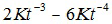 ) Eq. 3.4
The general equation for all force pairs is:
 =
=  Eq. 3.5
F1 – F2 = 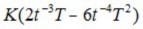 Eq. 4.1
And the general equation for all force pairs:
Fn – Fn+1 =  Eq. 4.1
Even when force pairs are normalized back to a single value, the total force is not zero because the factorial term increases the value of successive force terms, and the net force then for all pairs is determined by the difference between the individual numbers in the factorial series, which is: n! = 1, 2, 6, 24, 120,…, which with the alternating signs is:
 n! = -1, 2, -6, 24, -120,…., which makes the force pair series:
 [(n!) + (n+1)!] = (2 – 1), (2 – 6), (24 – 6), 120 – 24),…
In Eq. 4.1, for instance, the net force is the difference between the individual forces:
F1 – F2 = Kt-2 (2 – 6) = -4 Kt-2. Eq. 4.3
Effects of Photon Force and Absolute Time
If photon force is the same thing as gravity, the force pair equation can be set equal to the acceleration of gravity (G) that occurs for an object with mass “m”:
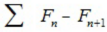 =
=  = mG Eq. 5.0
Since “T”in Eq. 5.0 normalizes all quantities of force back to their first value, the magnitude of force depends only on the sum of factorial terms “N”, and:
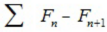 =
=  = mG Eq. 5.1
In high energy physics, mass and energy are equivalent, and the masses of high velocity particles can be represented by their equivalent photon energies. While it cannot be assumed that this holds for particles at low energies, if it does then their masses can be defined as:
 , Let:
  Eq. 5.2
The period of photon force in Eq. 5.1 can also be expressed in terms of photon frequency, in which case:
 =
=  Eq. 5.3
Substitute Eqs. 5.2 and 5.3 into Eq. 5.1 and solve for photon force frequency (f):
 Eq. 5.4
The frequency of a gravitational field is a periodic oscillation of a quantity that is the gravitational constant (G) times the photon mass-energy frequency, this divided by “N” times the speed of light “c”. If the field is to be calculated for more than one particle, the number of particles is multiplied by the “ ” term. However, an increase in this term would be countered by a corresponding increase in the number of photon force events “N”, so neither the constant of gravity would change, not the frequency of gravity.
Future physics will have to develop equations for faster than light velocities. The following is an attempt to do so.
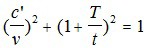
Let:  ; v = velocity of object. The ratio of “T” and “t” is: